Posted on 11 June 2025
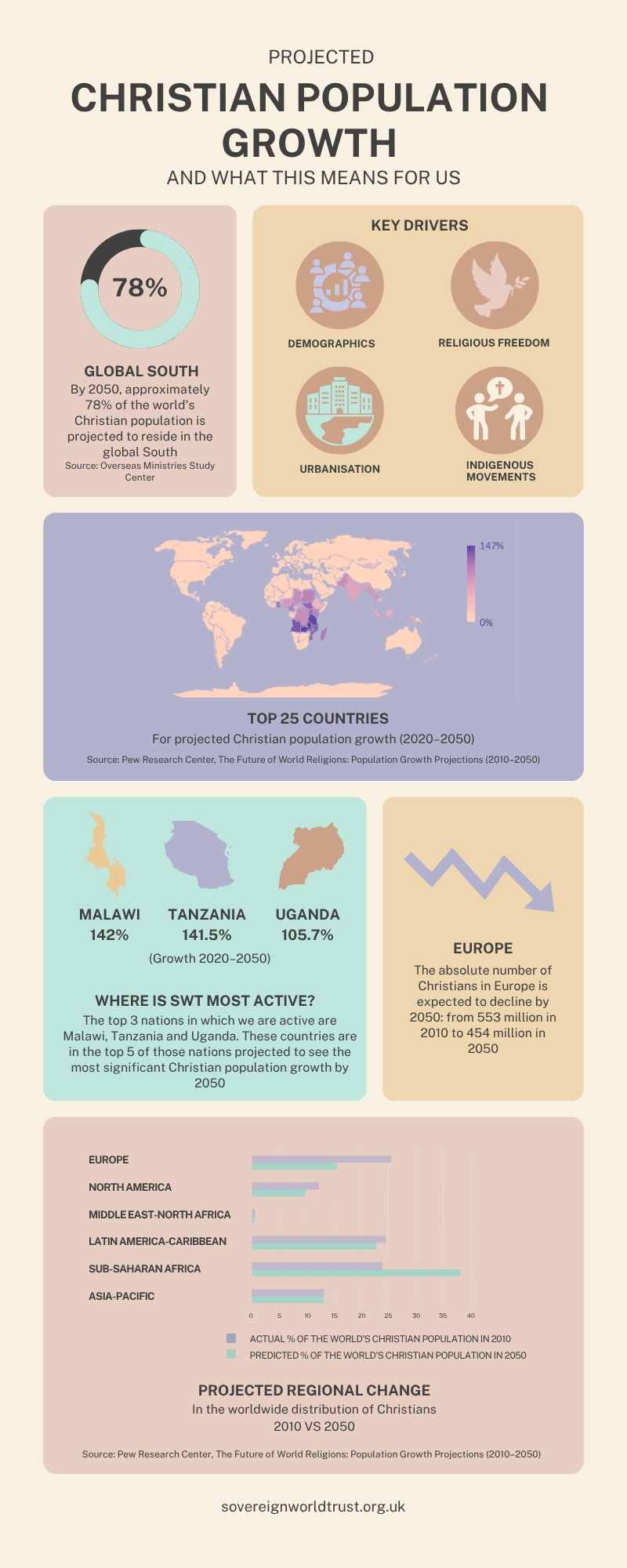
Christianity is growing in dynamic and often unexpected ways across the globe. According to the Centre for the Study of Global Christianity at Gordon-Conwell Theological Seminary, the global Christian population is on track to approach three billion by 2050.
This expansion is most visible in regions with high population growth and among communities where Christianity is still a relatively new faith, especially among younger generations. The Global South, including sub-Saharan Africa, parts of Asia, and regions of Latin America, is at the forefront of this movement. These areas are becoming the epicentres of global Christianity and will shape its future for generations to come.
For us at Sovereign World Trust, this information plays a vital role in our future planning. If we are to remain effective and faithful stewards of our mission, we must continue to target our resources toward regions where growth is strong but access to authentic Christian teaching and discipleship resources is limited.
Below is a snapshot of the top 10 countries projected to see the most significant Christian population growth by 2050, based on current demographic and religious trends. Significantly, the top 3 nations in which we are active are Malawi, Tanzania and Uganda, closely followed by Kenya and Nigeria. (Zambia being one of the countries most affected by Covid and post covid restrictions.) The reason for this is not so much that we have kept a vigilant eye on the trends, but rather these are the nations where God has provided us with good contacts over several years and especially at the present. We are encouraged and reassured that God has been guiding our efforts.
| Rank | Country | Projected Christian Population (2050) | Growth rate % |
Notes |
|---|---|---|---|---|
| 1 | Zambia | 43.2 million | 147% | High growth despite limited state support. |
| 2 | Malawi | 41.9 million | 142% | Expanding rapidly with minimal government backing. |
| 3 | Tanzania | 93.6 million | 141.5% | Growth driven by local evangelism efforts. |
| 4 | Uganda | 81 million | 105.7% | Christian population set to double. |
| 5 | Madagascar | 44.4 million | 91.4% | Growth despite a slight dip in percentage share. |
| 6 | Kenya | 79.8 million . | 79.5% | Strong, steady growth supported by infrastructure |
| 7 | DR Congo | 141.8 million | 73.9% | Largest absolute increase in Christian numbers. |
| 8 | Nigeria | 154.8 million | 61.2% | Substantial growth amid religious diversity. |
| 9 | Philippines | 143.6 million | 40.3% | Urbanisation and faith-based institutions fueling growth. |
| 10 | Ethiopia | 84.8 million | 35.4% | Continuing expansion in a historically Christian nation. |
Source: Pew Research Center, The Future of World Religions: Population Growth Projections (2010-2050).
Africa
Africa's Christian population has grown from 9 million in 1900 to over 718 million in 2023, a transformation largely driven by high fertility rates, local evangelism, and the rise of independent churches. By 2050, sub-Saharan Africa alone is expected to have over 1.1 billion Christians, making it the single largest Christian demographic block globally.
Asia
While overall growth in countries like India may be less dramatic, regional shifts are significant and demand our attention. For instance, in Punjab, over 350,000 people reportedly converted to Christianity between 2023 and 2025. This growth, driven by both demographic changes and religious conversions, highlights the need for region-specific outreach and resource allocation. These kinds of localised trends are vital to our forward planning.
Several forces are fuelling this remarkable global expansion:
While the statistics are impressive, the spiritual significance is far greater. This isn't just about numbers, it is about lives transformed, communities renewed, and the gospel reaching every corner of the earth.
This global shift offers us hope and responsibility. As members of the global Christian community, we are called to recognise these trends and respond with action, support, and prayer. Now, more than ever, it is essential that we stand ready to equip new believers, support local churches, and invest in resources that nurture lasting faith.
Whilst the message from these statistics is encouraging and affirming, it is also sobering. Such rapid growth brings the challenge of staying on track. The danger of syncretism, (mixing the gospel with wrong ideas, taken from other religions) or unbalanced teachings (based on reduced and one-sided readings of scripture) are ever present. Our aim is to provide training literature that will help promote healthy church growth.
Sources:
Pew Research Centre, The Future of World Religions: Population Growth Projections (2010-2050)
Centre for the Study of Global Christianity at Gordon-Conwell Theological Seminary
News Archive
Most recent itemsOctober 2026 (1)September 2026 (2)August 2026 (1)July 2026 (2)May 2026 (1)April 2026 (1)March 2026 (1)February 2026 (2)January 2026 (3)December 2025 (1)November 2025 (1)October 2025 (3)September 2025 (1)August 2025 (1)July 2025 (2)June 2025 (1)May 2025 (1)April 2025 (2)March 2025 (2)February 2025 (1)January 2025 (2)December 2024 (2)November 2024 (1)October 2024 (2)September 2024 (2)August 2024 (1)July 2024 (1)June 2024 (2)May 2024 (1)April 2024 (3)March 2024 (1)January 2024 (3)December 2023 (2)November 2023 (2)October 2023 (2)September 2023 (1)August 2023 (2)July 2023 (2)June 2023 (1)May 2023 (2)April 2023 (2)March 2023 (3)February 2023 (2)January 2023 (2)December 2022 (2)November 2022 (2)October 2022 (1)September 2022 (3)August 2022 (2)July 2022 (2)June 2022 (4)May 2022 (2)April 2022 (1)March 2022 (2)February 2022 (2)January 2022 (2)December 2021 (1)November 2021 (2)October 2021 (1)September 2021 (3)August 2021 (1)July 2021 (1)June 2021 (2)May 2021 (2)April 2021 (1)March 2021 (2)February 2021 (1)January 2021 (2)December 2020 (2)November 2020 (2)October 2020 (3)September 2020 (3)August 2020 (2)July 2020 (3)June 2020 (3)May 2020 (4)April 2020 (4)March 2020 (2)February 2020 (2)January 2020 (2)December 2019 (2)November 2019 (2)October 2019 (2)September 2019 (2)August 2019 (2)July 2019 (2)June 2019 (2)May 2019 (2)April 2019 (5)March 2019 (1)February 2019 (4)January 2019 (3)December 2018 (1)November 2018 (2)October 2018 (2)September 2018 (1)August 2018 (1)July 2018 (2)June 2018 (2)April 2018 (5)December 2017 (2)November 2017 (2)October 2017 (2)September 2017 (7)

Sovereign World Trust
P.O.Box 777
Tonbridge
Kent TN11 0ZS
(NOT for sat navs!)
We are a UK registered charity, No 1198177
If you are eligible to order books for your ministry, we have a separate site.
Learn more...Email - info@sovereignworldtrust.org.uk
Telephone - +44 (0)7458 626422
Website design and development by Interface CMS
